
Shopify vs WooCommerce for SEO
Both Shopify and WooCommerce can rank well, but they differ on control, URL structure, and speed. Here is how to choose through an SEO lens.

You know how frustrating it is to invest heavily in an online store only to watch organic traffic flatline.
We see this happen constantly with Malaysian SMEs and enterprise brands making platform choices based purely on design. The data from early 2026 shows Malaysia’s e-commerce revenue hitting a massive RM937.5 billion. Capturing your share of that market requires a technical foundation built for Google.
We founded Adam SEO back in 2011 because search engine rankings alone are meaningless without tangible business results. The shopify vs woocommerce seo debate usually ignores the technical trade-offs that dictate those sales. Let us look at the hard data comparing these systems and explore the practical ways to optimise your setup.
Crawlability and Speed for Shopify vs WooCommerce SEO
Both platforms offer fast and crawlable frameworks, but they achieve this through entirely different methods. Shopify guarantees consistent speed through its native content delivery network, while WooCommerce relies heavily on your choice of hosting and server configuration.
We consistently find that speed dictates user retention in e-commerce. A 2026 Google Chrome UX report shows nearly 80% of Shopify stores pass Core Web Vitals right out of the box.
Consider these performance benchmarks before choosing:
- Built-in optimization: Hosted platforms serve WebP images automatically to reduce file weight.
- Server response times: A premium local host in Malaysia costs between RM20 to RM300 monthly.
- Traffic resilience: Managed infrastructure prevents server crashes during major sales events.
Our team recommends investing heavily in local server architecture for self-hosted setups. If you skimp on your hosting environment with budget options, your store will suffer from slow server response times and poor crawl rates.
Schema Control
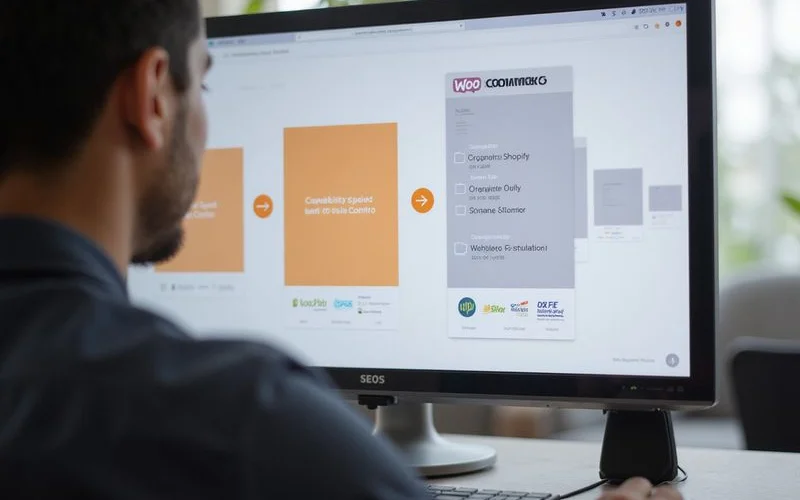
WooCommerce provides absolute control over your schema markup via dedicated plugins, allowing you to inject highly specific structured data. Shopify supports basic schema natively, but it imposes rigid constraints based on your theme’s Liquid code and third-party apps.
We consider structured data non-negotiable for winning rich snippets on search engine results pages. Google needs this code to display your product prices, reviews, and stock availability directly in the search results.
Advanced Markup Options
A WordPress environment lets you install powerful tools like RankMath PRO or Yoast SEO. These plugins give you line-by-line control over your JSON-LD output. You can easily map custom fields to specific schema properties, which is invaluable for a niche brick-and-mortar business in Malaysia with unique product attributes.
Our experience with hosted platforms reveals a steeper learning curve for custom schema. You will likely need a paid application like Booster SEO to expand your structured data capabilities. Modifying the native schema often requires hiring a developer to edit your theme.liquid files directly.
URL Structure
Shopify restricts your site architecture by enforcing fixed URL prefixes such as /products/ and /collections/. WooCommerce grants you complete flexibility to create flat, custom, or deeply nested URL strings without any forced directories.
We know that clean, localised URLs perform better in regional search results. If you want to target Malaysian keywords like “baju kurung” directly off your root domain, an open-source platform makes that simple.
The Duplicate Content Challenge
The rigid path logic on hosted platforms often creates unexpected SEO hurdles. A single item assigned to multiple categories generates multiple distinct URLs, such as /collections/summer/products/shirt and /products/shirt. This default behaviour dilutes your link equity.
Our standard fix involves modifying the theme code to strip the | within: collection tag. This forces all internal links to point to the canonical product path.
Here is how the two systems handle basic site architecture:
| Feature | WooCommerce | Shopify |
|---|---|---|
| URL Customisation | 100% Flexible | Restricted prefixes |
| Localised Subfolders | Native support (e.g., /ms-my/) | Requires Markets app |
| Duplicate URLs | Rare out of the box | Common with collection tags |
App/Plugin Ecosystem and Migration
Both platforms boast massive ecosystems of extensions to enhance your technical SEO and marketing capabilities. Migrating between them requires a flawless URL map and a strict redirect plan to prevent catastrophic traffic losses, so work through a full website migration SEO checklist before you switch.
We rely on these ecosystems to automate repetitive optimisation tasks. A WordPress setup offers over 60,000 free and premium plugins, giving you a tool for virtually every technical requirement. The app store on the competing platform is more curated but heavily favours monthly subscription models.
Protecting Your Organic Traffic
Switching platforms is dangerous without proper planning. Industry research from 2026 shows that 78% of site migrations suffer immediate ranking drops due to poor redirect mapping. Google will penalise your site if it encounters thousands of broken links after a launch.
Our migration protocol always includes comprehensive 301 redirects using a dedicated migration tool like Cart2Cart or Matrixify.
You must secure these three elements before taking a new site live:
- Exact URL matching: Map every old product path to its new destination.
- Meta data transfer: Move all title tags and descriptions cleanly.
- Immediate resubmission: Push your new XML sitemap to Google Search Console immediately after launch.
We hope this comparison clarifies the technical realities behind your platform options. A beautiful storefront is useless if your target audience cannot find it on Google. The right choice for your shopify vs woocommerce seo strategy depends entirely on your internal resources and your appetite for technical management.
Ready to put this into practice? Explore our E-commerce SEO service or request a free proposal.
Frequently Asked Questions
Which is better for SEO, Shopify or WooCommerce?
Is it hard to migrate between platforms?
Ready to turn this into results?
Get a free discovery audit and a clear, ROI-focused plan for your business.
See E-commerce SEO Malaysia